Wednesday, October 31, 2012

What Makes the Perfect Stock? Five Key Components.

There are a lot of different factors that combine to make the perfect stock, and even then, there is no guarantee of success. Nonetheless, this article will try to identify some key components every investor should consider when hunting for the next money-making opportunity.
 
What to look for in your next stock investment?
 
1. Growth: Healthy growth in revenue is a good start for any quality investment. Preferably, a rate of 15% over the last five years would be ideal, but sometimes there may be glitches along the way due to recessions and business restructuring.
 
2. Profit Margins: How much money the company actually earns in profit for each dollar the company generates in revenue. Somewhere in the range of 15% or more would be healthy, and provide some cushion for pricing pressure and new competition in the market. Some businesses, like grocery stores, however, have chronically low profit margins, which is evidence of stiff market competition.  
 
3. Balance Sheet: Essentially, the more money the company has borrowed, the less of a stake in the company its shareholders have should things turn south. Try to find a company that has a lot of assets compared to its liabilities. If a company has no long-term debt, that would be ideal, but of course this is rare. A debt-to-equity ratio is often utilized in this area, and if so, try and keep it below 50% debt.
 
4. Valuation: This is generally a comparison of the price of the stock in relation to its earnings. Anything over 20 times a 3-5 year earnings average is too expensive for most businesses, and under 15 times would be best as long as the company displays other signs of health, like those mentioned above.
 
5. Dividends: A dividend is how much money the company returns in cash to its shareholders. Dividends vary widely, and it is important to remain principled in this area. It is easy to go chasing stocks that do not pay a dividend, but it can become dangerous as dividends can be used as a good indicator of overall financial health. Ideally, a dividend of over 2% would be considered healthy.
 
Cheers,
 
Happy Investing Intelligent Investors, and please remember to share this blog with others!
 
Matthew.

Sunday, October 21, 2012

Why Gold? Inflation and the Dollar.

During economic uncertainty it has become essentially economics canon to purchase and stockpile gold as an investment or hedge. Why is this the case? Clearly, gold has little or no practical uses. Of course, it used as jewellery, and has a number of uses in the field of electronics manufacturing, but not nearly enough to support present-day production and supply. 

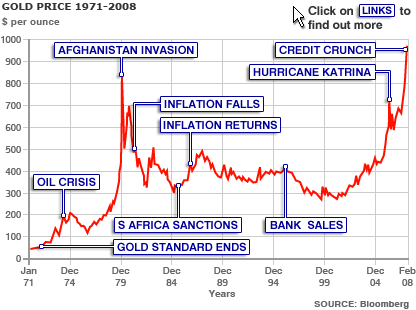
Prior to Nixon removing America from the gold standard in 1971, the U.S. dollar was pegged at $35 per ounce of gold. After 1971, the U.S. dollar essentially became a free-floating currency backed by nothing but our imagination. To help hedge against this uncertainty, it became increasingly important for a lot of investors and wealthy individuals to store a certain amount of their savings or reserves in the form of gold to prevent being stung by a collapse in the U.S. dollar. 


Currently at $1721, gold has continued its stratospheric move upward, primarily due to perceived instability and over-supply of the U.S. dollar. So why do people buy gold? They expect inflation, or a general decline in the purchasing power of their currency. One ounce of gold, for instance, could buy a fine suit in 1971 and in 2012, but in dollar terms, the same suit would have increased in cost from less than $100 to $1700... If someone had held their reserves or savings in cash during this period, their buying power would have essentially completely collapsed. If, therefore, you have a reasonable amount of savings, you do not want to hold it in cash or low-interest savings accounts for any extended period of time! It is almost guaranteed to lose its value.

Some other more generalized reasons for why people choose to invest in gold are as follows:

  • It is durable - it doesn't corrode.
  • It is divisible and homogeneous - you can break it up into smaller amounts.
  • It is easily recognisable and hard to counterfeit.
  • It has a stable supply because it is hard to get out of the ground.
  • It is portable.
  • It has a strong history accepted as a medium to facilitate exchanges. 
Keep in mind, however, that gold does experience wild swings in popularity amongst both central governments and investors, and thus can leave even astute and Intelligent Investors in substantial negative territory for some time in dollar terms. So buying gold is not a sure-fire way to curb against inflation, but included in a basket of resources it is a nice start.

Cheers and happy investing!

Matthew. 

Saturday, October 20, 2012

HP (NYSE:HPQ): Un-Loved and Under-Appreciated.

Investors have driven shares in HP down over 41% this last year, and down over 71% in a five year period. The turnaround plan under Meg Whitman seems to be going nowhere, and investors are concerned that a trend toward tablets will destroy personal computer sales. We are seeing this same concern drive down shares in both Intel and Microsoft as well recently.
 
There are, however, some things to love about Hewlett Packard:
 
1) The company is expected to earn over $7 Billion in profits next year. With a market capitalization currently of about $28 Billion, that represents a multiple of only 4 times! Paying four times earnings for a company represents an earnings yield on your investment of 25%! Not bad for a brand-name technology titan that definitely has the balance sheet to stay competitive for some time to come.
 
2) The company recognizes that it is facing problems, is not in denial, and is actively engaging in cost-cutting and turnaround efforts.
 
3) The company pays a dividend of 3.65%. In today's low-rate environment a dividend over 3% represents a reasonable return on your savings, and since the company is currently trading at a low multiple to next year's earnings, there is up-side potential in the stock as well.
 
4) The company is #1 or #2 in a wide number of product markets. Though many think of HP as primarily a PC manufacturer, it has leading positions in servers, storage, networking, software, systems management, and printers as well. Essentially, the company began diversification efforts long-ago, and they have paid-off. As PC sales decline, other units of the company should be able to pick up the slack.
 
Of course, no technology investment is without a higher degree of risk, but HP is definitely worth a look for the Intelligent Investor.
 
Cheers, and happy investing!
 
Matthew.  

Monday, October 1, 2012

Tim Horton's Rises in Zagat Survey. Now 5th in the United States. Expansion Continues.

Tim Horton's is now listed as one of the best fast-food restaurants south of the border. Having put itself up against stiff and entrenched competition from global super-powers, such as Starbucks and McDonald's, Tim's has proven itself to be a formidable Canadian competitor.

Last year, Tim Horton's was ranked 22nd in the same survey, so this represents a small victory for the Canadian chain. Brand recognition is still nowhere near as strong as it is north of the border, but it is successfully using its Canadian stronghold to pour resources into the American market.

There are now over 700 Tim's locations in the United States, and another 80 to 100 Tim Horton's stores will be added in 2012.

Intelligent Investors, be sure to keep a pulse on Tim Horton's shares as they further expand in the United States. The American market is huge and has lots of opportunity.

Cheers,

Matthew.

Sent with the BlackBerry Bold 9900.

Monday, September 17, 2012

Cash Rich Canadian Companies.

Bank of Canada governor Mark Carney has been complaining recently that Canadian businesses are not doing their fair share to boost the economy. He is demanding that they spend some of their cash hoards, or return it to shareholders in the form of dividends so that they can spend it.

About 70 percent of all economic growth is from personal consumption, so the governor's words are warranted in the sense that cash sitting in corporate bank accounts cannot exactly help you and I go buy more stuff to boost national GDP. But what is the other alternative? Raise corporate taxes and use the increased government revenue to pay for infrastructure development and other government programs... Most business leaders, however, would protest at the prospect of tax increases so loudly that any common sense would be quickly thrown aside.

So who are the cash-rich Canadian companies referred to so much by Mark Carney? Below I have listed some of the biggest:

George Weston Ltd. ($3.6 Billion)

Air Canada ($2.38 Billion)

Research in Motion ($1.9 Billion)

Suncor ($5.1 Billion)

Teck Resources ($3.64 Billion)

Bombardier ($2.47 Billion)

For the Intelligent Investor, try to always keep a nice portion of your portfolio concentrated in cash-rich enterprises. As a shareholder, their bank account is your bank account, and you want to make sure to avoid businesses with a poor record of accumulating and saving cash on the side for emergencies.

Cheers, and Happy Investing!

Wednesday, September 12, 2012

Acquisitions are Good Investment Catalysts for Canadian Investors. Shoppers Drug Mart, Bell Alliant, Manitoba Telecom, and Corus Could be Potential Targets.

One of the most important things to examine regarding a potential investment opportunity is whether or not there might be a catalyst in the coming months or years. What do I mean by a catalyst? Something that will cause the price of the stock, and the associated value of your investment, to change. Potential catalysts might be a dividend increase, an upward revision or increase in a company's earnings guidance, a new product development et. cetera. Another key catalyst, and one which will be examined in this posting is that of a potential acquisition.

A potential acquisition generally causes an upward movement in the price of the company being acquired, and often a downward movement in price for the company making the purchase. Why? Existing shareholders of the company being acquired need to be compensated enough to encourage them to want to sell their stock, and the company making the purchase often has to pay well-over fair or book value for the company it is buying in order to get the shareholders to agree to the offer. 

Are there any Canadian companies that might be the target of an acquisition going forward?

Below I have listed four Canadian companies that appear to be nice targets for a number of large and cash-rich businesses:

1) Shoppers Drug Mart (TSE:SC)

Shoppers is a healthy and profitable company with a loyal following. U.S. Based Walgreen Company (NYSE:WAG) is poised for Canadian expansion. 

2) Bell Alliant (TSE:BA)

A declining land-line revenue stream, but an acquisition hungry and cash-rich partner in Bell Canada Enterprises (TSE:BCE). 

3) Manitoba Telecom (TSE:MBT)

With limited growth, and a declining land-line revenue stream, Manitoba Telecom management could look kindly to cash-in and take a healthy buyout from Telus (TSE:T) or Bell (TSE:BCE).

4) Corus Entertainment (TSE:CJR.B)

With the rampant media consolidation happening in Canada right now, Shaw Communications (TSE:SJR.B) would be a likely suitor for Corus.

Full Disclosure: Matthew Clarke owns or indirectly controls shares in Shoppers Drug Mart and Bell Canada. 

Thursday, August 16, 2012

Maple Leafs, Toronto FC, the Raptors, and the Marlies Under the Control of Bell and Rogers. Great Cash-Flow for Bell (TSE:BCE) and Rogers (TSE:RCI.B).

Good news for owners of Bell (TSE:BCE) and Rogers (TSE:RCI.B) today as the CRTC has approved their purchase of Maple Leaf Sports and Entertainment (MLSE).

As part of the conditions to the approval, Bell and Rogers have to invest $7.5 million over the next seven years on new sports themed programming by independent Canadian producers. Essentially, a drop in the bucket for the billion dollar Canadian media titans.

MLSE, and now Rogers and Bell, own the Toronto Maple Leafs, the Toronto Raptors, the Toronto FC, the Toronto Marlies, Leafs TV, Gol TV and NBA TV Canada, as well as two other services that have not yet launched. As a whole, MLSE will be a cash-cow for its new owners, and an excellent source of new incomes for future dividend increases.

Since Rogers already owns the Toronto Blue Jays, the Rogers Centre, and Sportsnet, and Bell owns CTV and TSN, as well as a minority ownership stake in the Montreal Canadiens, the two companies are cementing a dominating position in Canadian media and entertainment.

Both Bell and Rogers already support healthy dividends and solid business franchises. The new acquisition bodes well for Intelligent Investors if they are looking for reliable income and cash-flow generation.

Full Disclosure: Matthew Clarke owns or indirectly controls shares in Bell Canada (TSE:BCE).

Wednesday, August 15, 2012

Great-West Life (TSE:GWO) Poised for Continued Growth and Dividends. Upgraded to Buy by Catalyst Research.

Canadian based insurer Great-West Life (TSE:GWO) has been upgraded to a buy by Catalyst Research. In their recent report, they noted that Great-West Life is "operating above expectations" and that the insurer "continues to be a steady earnings performer." 

1 Year Performance for Great-West Lifeco
Chart from Big Charts

Earnings per share for the last quarter rose 8%, and operating return on equity is close to 16%, the highest among Canada's life insurance companies. Earnings for 2012 are expected to be in the range of $2.05 per share, and with shares currently selling for about $22, that represents a significant value for shareholders. 

At only 10 times 2012 earnings, Great-West Life provides an excellent earnings stream to its owners at a better valuation than the overall market and many other financial companies. 

The dividend payout ratio (or percentage of the company's earnings that are returned to shareholders in the form of a dividend payment) is expected to be 55%, which is fairly low and sustainable over the longer-term. What is Great-West Life's Dividend Yield? 5.5%! In today's current low-yield environment, a dividend of this stature is hard to pass up, especially when it is backed by healthy earnings power.

For the Intelligent Investor, Great-West represents a strong value and a disciplined choice. 

Cheers and Happy Investing. 

Full Disclosure: Matthew Clarke owns or indirectly controls shares in Great West Life (TSE:GWO). 

Tuesday, August 14, 2012

Netflix CEO Buys More Facebook (Nasdaq:FB). Is Facebook a Good Value? Or are Other Technology Companies Cheaper?

Netflix (Nasdaq:NFLX) CEO Reed Hastings bought 48,000 shares of Facebook (Nasdaq:FB) last week at a price of $21 per share. Hastings already holds about 20,000 shares, which brings his holdings to about $1.5 million.

Hastings currently owns $62 million of Netflix stock, and $5.4 million of Microsoft (Nasdaq:MSFT), so Facebook is not one of his larger holdings. Generally, an insider (like a member of the board of directors) is seen as a positive sign for a company's health. Insiders should know more than the general public, so if they are buying, perhaps they know some good news that might be on the way.

Does Hastings know something that we know? Perhaps, but that does not necessarily mean that Facebook is a good investment at today's levels... and certainly not at its IPO price of nearly $40. Since making their début on the market, Facebook has lost nearly 50% of its value. Once thought to be a $100 billion company, the shares are now worth about $40 billion.

Facebook is cash-flow positive to the tune of about $639 million over the last 12 months, but technology requires continued and significant investments in research and development to stay competitive... so the valuation has to be right to invest.

Facebook Cash Flows:


So what is a good value for Facebook? Most people have no idea! And that should be scary for any investor. Sure, it has about 900 million users... but how many will continue using Facebook? How many accounts are doubles or fakes? How many users actually click on the advertisements? How many new users will join once it is solidified as the social networking tool for old fogies that graduated from school years ago?

Are there other technology companies cheaper than Facebook? Google (Nasdaq:GOOG), Microsoft (Nasdaq:MSFT), Intel (Nasdaq:INTC), Oracle (Nasdaq:ORCL), Apple (Nasdaq:AAPL), Cisco (Nasdaq:CSCO), the list goes on and on and on...

Cheers and Happy Investing Intelligent Investors.

Home-Depot (NYSE:HD) Reaches Turning Point. Richelieu Hardware (TSE:RCH) a More Interesting Investment.

Atlanta based Home-Depot (NYSE:HD) announced a 12 percent increase in earnings and a positive outlook for the remainder of the year.

Home-Depot, the largest home improvement retailer in he world, struggled under the weight of the American housing collapse, but now looks poised for continued strength going forward.

Citing its performance this year, Home-Depot raised its earnings guidance to a respectable $2.95 per share. At a price of $54 per share, that represents a valuation of 18 times one year of earnings. For a fairly mature retailer, a valuation of 18 times earnings is not cheap, so at present levels growth in earnings would be needed for the Intelligent Investor.

The balance sheet of Home-Depot, however, is clean, with about $10 to $11 billion in long-term debt under assets of about $40 billion, so there is little concern in this area:


Should the housing market continue to improve, Home-Depot will show more strength, but since the stock is already up almost 80% during the past year, an improvement in the American housing market is clearly already priced into the shares.

For those interested in something a little off the beaten path in the hardware area, investigate Richelieu Hardware Ltd., (TSE:RCH) a Canadian concern with steady growth, a reasonable valuation, and little debt.

Cheers Intelligent Investors.